Search Everywhere Optimization: Why Google Alone Is No Longer Enough for Local Businesses

Jeanette Eberhardt
Founder, Avenue Twenty Media
Published March 4, 2026
There are over 50 billion searches happening every single day.
Only a fraction of them happen on Google.

If your marketing strategy still revolves around “ranking on Google,” you're optimizing for yesterday’s internet.
People are no longer typing short keywords like:
-- “roofing company”
-- “real estate agent”
-- “med spa near me”
They are asking full questions.
They are searching in phrases like:
-- “Who is the best roofer in my area that actually answers the phone?”
-- “Why won't my HVAC company call me back?”
-- “What’s the difference between Botox and filler and which one lasts longer?”
-- “Is there a real estate team that specializes in luxury homes in Surprise AZ?”
And they are asking those questions across:
YouTube
Instagram
TikTok
LinkedIn
Facebook
Pinterest
Reddit
AI tools
Google Maps
Apple Maps
Voice assistants
And AI-powered chat systems
Google is no longer the gatekeeper of attention.
What Is Search Everywhere Optimization?
Search Everywhere Optimization is the discipline of showing up where your customers are asking questions.
-- Not just ranking.
-- Not just posting.
-- Not just running ads.
But becoming the obvious authority across platforms when someone searches in full sentences.
When someone asks:
-- "Why does my garage door opener keep making that grinding noise?"
-- "Who installs high-end outdoor kitchens near me?"
-- "How do I know if I need a new roof or just a repair?"
You should be visible in multiple places with consistent messaging.
That consistency signals authority, not just to people, but to algorithms.
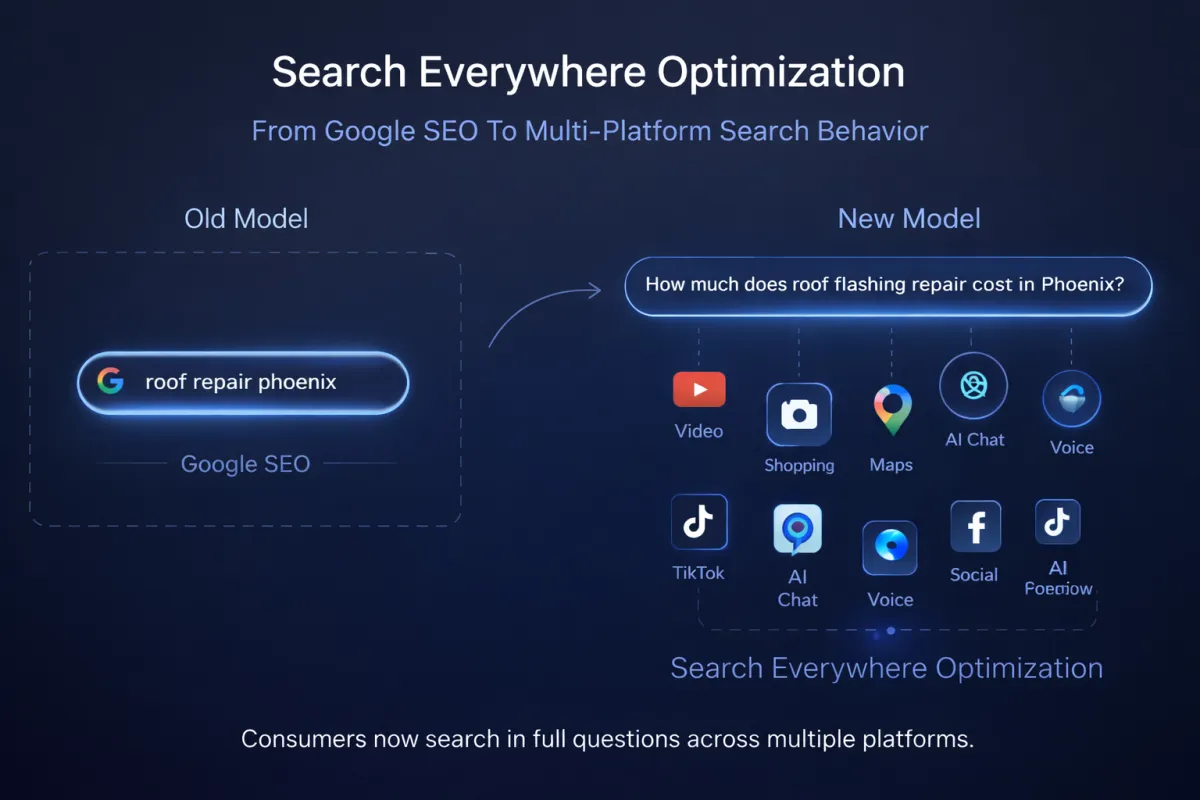
The Old Model: SEO Was About Keywords
For years, SEO meant:
-- Pick keywords
-- Build backlinks
-- Optimize title tags
-- Hope for ranking
-- Those tactics still matter.
But today, search engines and AI tools analyze context, consistency, and expertise.
They analyze signals like:
-- Are you publishing content on this topic regularly?
-- Are you answering real-world questions?
-- Are people engaging with your brand across platforms?
-- Does your authority exist beyond a single website?
If your entire authority lives on one domain, your visibility is fragile.
The New Model: Authority Signals Across Platforms
Search Everywhere Optimization works because it mirrors how people actually behave online.
A homeowner might:
1. Google a phrase.
2. Watch a quick YouTube for explanation.
3. Look at Instagram photos.
4. Check reviews on Maps.
5. Ask an AI tool for a summary.
6. Click through to your website.
If you only exist in Step 1, you lose the deal.
Local businesses must now think in conversational phrases, not just keywords.
Instead of optimizing for: “roof repair Phoenix”...
Optimize for questions like:
-- “How much does it cost to repair roof flashing in Phoenix?”
-- “Can roof leaks cause mold in my attic?”
-- “Is it better to patch a roof or replace it?”
These are the searches happening now.
Why This Matters For Local Businesses
Local service businesses are especially vulnerable to this shift.
Why?
Because visibility and response time now determine who wins the customer.
If someone searches: “Is there a landscaper near me that actually answers the phone?” And your competitor has...
Google Reviews
YouTube shorts
Clear service expectations
An AI receptionist answering instantly
They win.
Search Everywhere Optimization is not about posting more content. It's about building topic clusters and answering the exact questions your customers are already asking.
The AI Slop Problem
Another issue is emerging this year, 2026. AI-generated generic content is flooding the internet.
Most of it is vague.
Most of it is repetitive.
Most of it answers nothing.
The solution?
It's not by producing more content. The solution is to produce specific, phrase-based content grounded in real-world expertise.
So What Should A Local Business Do Now?
1. Identify the top 20 real questions customers ask when the call your business.
2. Turn those questions into clear conversational blog posts.
3. Repurpose each post into:
A LinkedIn article
A YouTube short
In Instagram reel
A Google Business post
4. Maintain consistent language acros splatforms.
5. Install automation that captures and responds to leads immediately
That is how modern authority is built.
Search is no longer about being first on Google. It's about being everywhere your customer looks next.